


Audio Precision's comprehensive range of audio analysis solutions was designed to meet the rigorous demands of audio engineers. From the industry-standard APx555 B Series, featuring the lowest THD+N in the world, to the value-oriented APx516B, our solutions support every stage of the product lifecycle. Whether you are pushing the boundaries of R&D, managing high-volume production lines, or testing electro-acoustic components like headphones and smart speakers, our analyzers deliver everything you need for designing superior audio performance.
Audio Analyzers

APx555B Series
Highest performance analog audio analyzer. Ideal for all applications that push the limits of analog audio performance.
Learn More
APx58xB Series
Exceptional analog performance and our highest channel density. Built for applications demanding many channels.
Learn More
APx52xB Series
A versatile 2-or-4 channel premium audio analyzer. For those who need higher performance with versatile digital I/O.
Learn More
APx517B Series
Engineered for production testing headphones, headsets, microphones and speakers. Fast setup and reconfiguration.
Learn More
APx516B Series
Built for comprehensive analog and digital R&D and production audio testing. Combines versatility and affordability.
Learn More
APx515B Series
A two-channel analyzer for production testing and entry-level R&D. Pairs speed, performance, reliability, and ease of use.
Learn More
APx511B Series
For engineers evaluating hearing instruments. Provides the measurements and I/O vital to the production test process.
Learn More
APx500 Flex
APx500 Flex Keys let you select any ASIO-capable audio interface for use with the APx audio measurement software.
Learn MoreAPx500 Audio Measurement Software
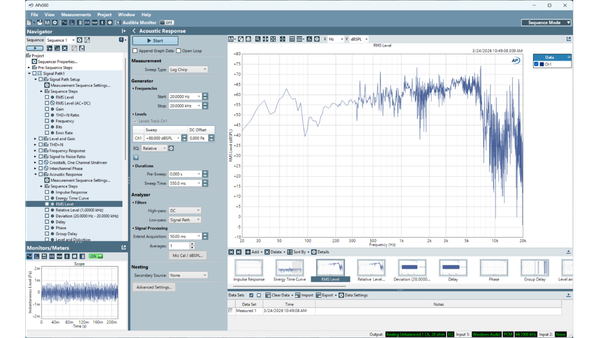
The APx500 Measurement Software is the most advanced audio measurement interface available. Complex test regimes can be created directly in the GUI, saving time and money on procedures requiring user prompts, limits, and calls to external applications. Audio Precision offers a wide range of options tailored to specific applications, including electro-acoustic testing, perceptual audio test, and speech intelligibility.
Benefits
• Built-in measurements
• Intuitive user interface
• Powerful automation features
• API integrations
• Subscription & perpetual license
Audio Analyzer Cables & Accessories
Browse All Accessories
Cables & Cable Kits
Ensure the integrity of your measurements with our custom-engineered cables, manufactured to eliminate measurement variables and maintain the highest performance of your AP audio analyzer.
Shop Now
APx1701 Transducer Test Interface
Designed for electro-acoustic testing, featuring dedicated power amplifiers to drive loudspeakers and headphones.
Learn More
SWR-2755 B Series Switcher
Offers significantly reduced crosstalk (18 dB better in unbalanced 600 Ω load and 10 dB better in balanced 600 Ω load).
Learn More
Switching Amplifier Measurement Filters
This switching amplifier is designed for Class-D amplifier testing, providing signal preconditioning to improve measurement accuracy.
Learn More

GRAS Microphones & Acoustic Accessories
Developed for R&D engineers and production technicians who need the highest possible performance, a broad range of digital I/O options and fast, intuitive software.
Learn More

